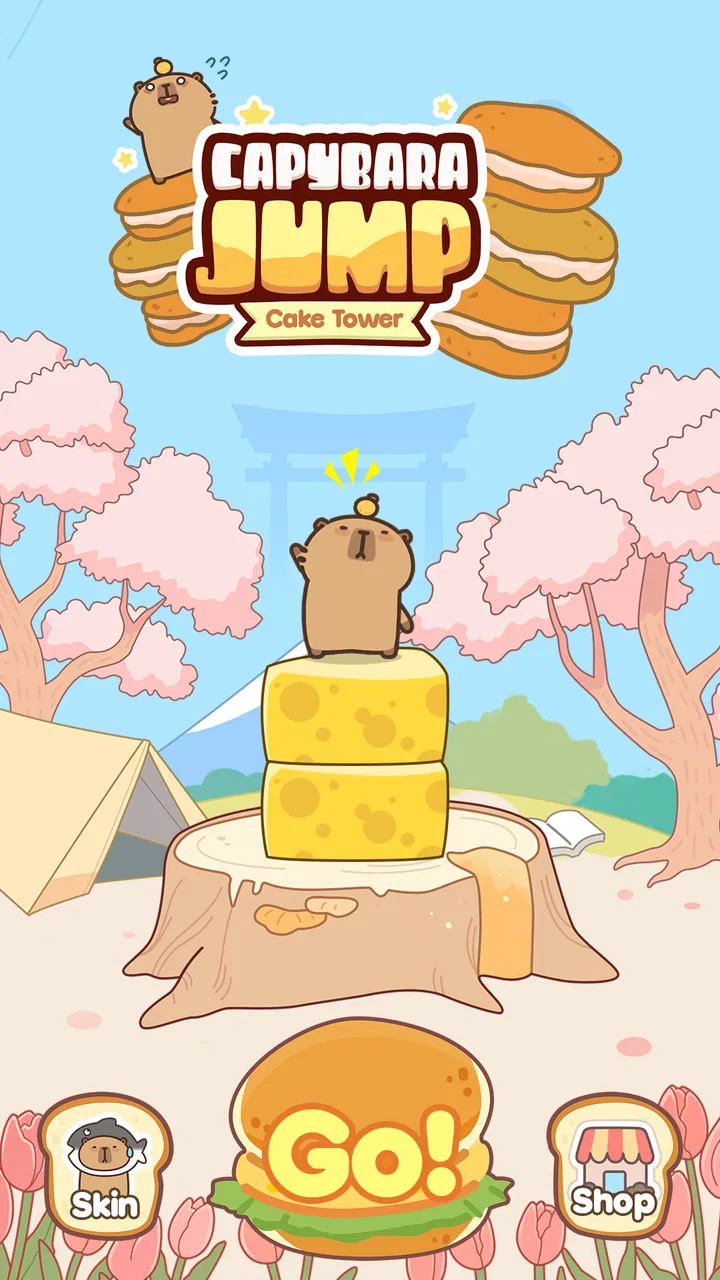
Capybara Jump: Cake Tower
- 4.5
- Rating
- 1.00M
- Installs
- Free
- Price

 Analysis by App-foxy
My first few minutes with Capybara Jump: Cake Tower were immediately easy to understand: a cheerful capybara jumps upward while I try to build the tallest possible cake tower. That simple idea gives the game a friendly, low-pressure identity, and the cute presentation does a lot of work before the mechanics have had time to become complicated. It is a casual game from CAT Studio, free to start, and rated for Everyone, so it is clearly aimed at short sessions rather than a demanding, story-heavy commitment.
The appeal is strongest when I want something I can open without preparation. There is no dense tutorial language to study and no complicated control scheme standing between me and the next attempt. I can play for a brief break, put it down, and return later without needing to remember a large set of rules. That makes it a natural fit for waiting rooms, a short commute, or the few minutes before bed when I want interaction rather than passive scrolling.
Its store presence reflects that broad appeal. The game has an average rating of 4.5 from around 35 thousand ratings and has passed 1 million installs, which places it comfortably among casual titles that have found a substantial audience. Those figures do not make it automatically perfect, but they do suggest that the basic combination of capybara charm and quick jumping has connected with many players.
You May Also Like

 Blood Strike: 2.5 Anniversary
Blood Strike’s Loadouts Turn Every Drop Into a Tactical Gamble
A close look at Blood Strike’s custom loadouts: how fast access to signature weapons reshapes its battle royale rhythm, rewards preparation, and narrows the gap between fights.

 Pandora - Music & Podcasts
Pandora’s Music Is Easy to Start, but Harder to Recover
Pandora’s strength is its low-effort path from a seed to a station. Its weak spot is how much confidence it asks you to place in connection, setup, and quiet recovery.

 8 Ball Pool
 Is Built on Rivalries, Rematches, and Routine
A close look at the rivalries, rematches, shared routines, and unanswered safety questions that turn a quick pool match into a persistent mobile community.

 Samsung Music
’s Quiet Strength Is Playing What You Already Own
Its reach comes less from spectacle than from dependable access to a personal library. That simplicity is both the app’s strongest retention engine and its ceiling.

 AccuWeather: Weather Radar
AccuWeather Review: A Quick, Clear Forecast for Everyday Decisions
For everyday plans, the best forecast is the one you can understand quickly. AccuWeather makes rain timing, radar, and local conditions easy to act on, with a few trade-offs.

 Hill Climb Racing
Why Hill Climb Racing Still Turns Crashes Into One More Run
A tiny car, a bumpy hill and one more upgrade: Hill Climb Racing keeps resurfacing because its simple chaos makes every near-miss feel personal.
More From Our News Desk
View All News


How the cake tower becomes a playable world
The most successful part of the presentation is its visual language. A capybara is already an unusually relaxed mascot, and placing that character in a cake-building challenge creates a playful contrast: the goal is to climb as high as possible, but the mood does not feel aggressive or stressful. The setting communicates sweetness and silliness before the player has to think about performance. I never feel as if the game is asking me to save a kingdom or defeat an enemy; it is asking me to keep a cute character moving upward.
That distinction matters in a crowded casual category. Many jumping games use urgency, danger, or increasingly frantic obstacles to hold attention. This one has a softer identity. The cake tower is not merely a background idea; it gives the upward movement a recognizable purpose. Each successful jump contributes to the visual joke of making the dessert taller, so the central objective remains readable even when I am playing casually.
I also like how the capybara keeps the experience from feeling like an abstract score challenge. A plain geometric character could make the same basic action feel mechanical, while the animal gives each attempt a little personality. The result is especially approachable for players who enjoy cute games but do not necessarily want a large collection of systems, menus, or long-term tasks.
There is a useful trade-off here. The visual concept is memorable, but it also sets a high expectation for variety. Once the player understands “jump upward and build the tower,” the art has to keep the repeated action feeling pleasant. The game’s charm can carry the opening sessions very well, yet players looking for a changing world, a narrative setting, or a large range of environments may eventually find the central theme narrow. I see that as a limitation of the format rather than a flaw in the core idea.
A visual identity that supports short sessions
For me, the art direction works best when I treat the game as a small mood piece rather than a complete adventure. The capybara and cake theme make it easy to return for one or two attempts without demanding emotional investment. That is a genuine strength for a casual title: I can enjoy the look of it even when I am not in the mood to chase a serious score.
It also makes the game suitable for sharing with younger players, although the age rating alone should not be treated as a promise that every family will enjoy the same level of repetition. An adult looking for a calm, accessible game may appreciate the same qualities as a child, but experienced arcade players may want sharper difficulty and more mechanical depth than this presentation suggests.
One practical tip is to judge the game by the quality of its individual attempts rather than by how much content I expect from a larger platform game. The cake tower gives each run a compact visual destination. If I approach it as a quick challenge with a pleasant character, the design feels coherent. If I expect a broad campaign with many distinct places to explore, the narrow setting becomes more noticeable.
Sound, timing, and the feeling of a good attempt
The game’s mood depends on more than its colors and character. In a jumping game, sound and timing need to support the player’s sense of rhythm. Even when the rules are simple, I need to feel that my actions belong to a predictable sequence: prepare, jump, land, then decide what comes next. The cake-tower premise gives that rhythm a light, almost toy-like quality instead of turning every mistake into a dramatic failure.
I found that this makes the game easier to approach in noisy everyday situations than a title that depends on a long story or constant dialogue. I can focus on the immediate action and let the cheerful setting provide the atmosphere. At the same time, players who prefer games with a strong musical identity or a more cinematic soundscape may find the experience deliberately modest. Its mood comes primarily from the character, setting, and repeated movement, not from elaborate world-building.
The pacing is also important. A casual jumper has to avoid two opposite problems: moving so slowly that every attempt feels empty, or accelerating so aggressively that the game becomes exhausting. The cake tower concept benefits from a measured pace because the visual reward is cumulative. I want to notice that the tower is growing, not simply survive a blur of obstacles. That gives the game a gentle sense of progress even when the underlying objective remains straightforward.
My advice is to play with the sound at a level that lets the timing remain comfortable rather than treating audio as decoration. If I am playing during a break, I do not need the game to dominate the room. The best use case is a quiet, focused burst in which the visual feedback and the cadence of jumping are enough to keep me engaged. That approach also helps reveal whether the game’s repetition suits me, because there is no story distraction hiding the central loop.
The limitation is that a soft mood cannot replace satisfying control. If a player wants constant musical changes, dramatic impact effects, or a soundtrack that becomes the main reason to continue, this is probably not the right choice. I would choose a rhythm-focused game instead in that situation. Here, sound works as support for the capybara’s relaxed world, and the game is better when I judge it by that restrained goal.
Where the simple mechanics fit—and where they do not
The core mechanic is easy to grasp: jump and build the highest cake tower possible. That clarity is a major advantage. I do not have to spend my first session learning several currencies, character abilities, or mission types before the game becomes enjoyable. The objective is visible in the action itself, which is exactly what I want from a quick casual game.
That simplicity also creates the main question for long-term players: is the act of repeating the climb enough? My answer depends on what I want from a mobile game. For short bursts, yes, the focused loop is useful. For someone who expects a deep progression system, a large collection of modes, or a substantial narrative, the same focus may feel limited. The game does not need to become something else, but the player needs to choose it for the right reason.
I particularly appreciate how the tower provides a natural way to measure an attempt without requiring a complicated scoreboard in my head. A higher cake is an instantly understandable sign that I played better or lasted longer. That makes it easy to set a personal target: beat the height from the previous break, reach a little farther before putting the phone down, or simply improve my consistency rather than chase an abstract achievement.
A less obvious benefit is that this kind of personal target makes the game work for different ages and skill levels. A new player can enjoy the character and the act of climbing, while a more practiced player can focus on cleaner jumps and a taller result. The same screen supports relaxed play and light self-competition. It is not a substitute for a serious competitive game, but it gives the simple loop more flexibility than the store summary alone might suggest.
There is also a useful decision point around purchases. The game is free, while its in-app items are listed between $2.99 and $4.99 each. I would begin without spending anything and first decide whether the basic jumping loop remains enjoyable after several short sessions. That is especially important here because the appeal comes from repetition; a purchase cannot fix a mechanic that does not suit my preferred pace. Players who enjoy supporting a small casual game may consider an item later, but I would not treat spending as necessary to understand the experience.
Because the current version is 0.0.44, I would approach it as a game that may still be developing rather than as a completely mature, feature-heavy package. That does not prevent me from enjoying the available loop, but it does shape my expectations. I would not choose it when I need the breadth and polish of a long-established arcade favorite. I would choose it when I want a compact, friendly game whose main idea is immediately available.
Who should install it, and who should skip it?
I recommend it to players who like cute mascots, short arcade attempts, and goals that can be understood without explanation. It is also a sensible choice for families seeking an Everyone-rated casual game with a harmless dessert theme. Someone who enjoys collecting personal bests in small increments may find the cake tower surprisingly effective as a motivation, especially when there is only enough time for a few jumps.
I would be more cautious if you need a game with a strong story, complex character development, strategic planning, or a wide selection of activities. Fans of elaborate platformers may find the central loop too focused. Players who dislike repetition should also think twice, because the capybara and cake setting are the attraction, but they do not change the fact that the same basic upward challenge is the heart of every session.
Compared with the usual endless jumpers, this game stands out through its softer character and dessert-based setting rather than through a complicated ruleset. Compared with idle cake or decorating games, it asks me to participate actively instead of simply waiting for numbers to rise. That middle position is its clearest niche: it is more hands-on than an idle title, but more relaxed and immediately accessible than a demanding platform challenge.
My atmosphere verdict after playing
What holds the experience together is the agreement between theme and mechanics. The capybara looks relaxed, the cake tower gives the climb a playful destination, and the short-session structure keeps the game from pretending to be a large adventure. When those parts are viewed together, the simplicity feels intentional. I am not entering a deep fictional universe; I am stepping into a small, cheerful challenge that wants me to try one more jump.
That coherence is the game’s strongest quality. The art does not promise a serious action experience, the setting does not demand a complicated explanation, and the pacing leaves room for casual play. Even the limitations become easier to understand because the game is so clear about its identity. The question is not whether it offers everything; it is whether its compact idea gives me enough pleasure to return.
For my everyday use, the best scenario is a short pause when I want something more active than watching videos but less demanding than a full game session. I can make a few attempts, focus on improving the height of the tower, and stop without feeling that I abandoned a mission. That makes it a good companion for fragmented time, provided I enjoy repeating a single central challenge.
CAT Studio has created a casual game with a distinct emotional tone rather than an overloaded feature list. The free entry point makes it easy to test, the Everyone rating keeps the concept broadly approachable, and the established audience suggests that the formula has real appeal. I would still skip it if my priority were depth, variety, or an elaborate soundtrack. But if you want a gentle vertical challenge wrapped in a cute cake-and-capybara world, this is a charming pick for small pockets of play.
FAQs for Capybara Jump: Cake Tower
01What is Capybara Jump: Cake Tower?
Capybara Jump: Cake Tower is a casual vertical platform game centered on a charming capybara climbing a tower made of cake-themed platforms. The main objective is to jump upward, land accurately, avoid falling, and reach higher sections while chasing better scores. Its cute presentation and simple controls make it easy to start, although later stages can require patience and careful timing.
02How do you play Capybara Jump: Cake Tower?
Gameplay is based on guiding the capybara from one platform to the next as it climbs the cake tower. Depending on the version and device, movement may rely on tapping, swiping, or tilting to control jumps and direction. The controls are straightforward, but successful runs depend on judging distances, reacting quickly, and learning the movement pattern of each platform.
03Is Capybara Jump: Cake Tower free to download and play?
The game is generally presented as a free-to-download casual title, allowing players to try the core climbing experience without an upfront purchase. However, free games may include advertising, optional purchases, or other monetization features. Before downloading, check the current Google Play or App Store listing for details about ads, in-app purchases, supported devices, and any regional differences.
04Does Capybara Jump: Cake Tower require an internet connection?
A game like Capybara Jump: Cake Tower may allow its basic jumping gameplay to work offline, which is useful for short sessions while traveling or when mobile data is unavailable. Nevertheless, advertisements, updates, rankings, cloud features, or purchase verification can require an internet connection. It is best to test the game offline after installation rather than assuming every feature works without connectivity.
05Is Capybara Jump: Cake Tower suitable for children?
The colorful capybara character, cake-themed setting, and uncomplicated arcade mechanics make Capybara Jump: Cake Tower appealing to younger players and casual gamers. Still, parents should review the store rating, advertising behavior, and in-app purchase settings before allowing children to play. The game may also become challenging because precise timing is needed, so younger users could benefit from supervision.
Pros
- Simple one-touch controls are easy for players of almost any age.
- Short levels make it convenient for quick gaming sessions.
- Cute capybara animations give the game plenty of visual charm.
- Gradual challenges help newcomers learn the timing without feeling overwhelmed.
- Offline play is useful when traveling or playing without mobile data.
Cons
- Repeated jumps and tower layouts may feel predictable after extended play.
- Precision sections can be frustrating when landing zones are especially narrow.
- Progress may feel slow if rewards or upgrades require frequent replaying.
- Ads can interrupt the experience
- depending on the version and device.
- The game offers limited depth for players seeking complex mechanics or strategy.

Capybara Jump: Cake Tower
Gallery